Male Categories
- Men's Athletic
- Men's Bodybuilding
- Men's Physique
- Men's Classic Physique
- Men's Sport Model
- Men's Beach Body
- Men's Formal Wear
- Men's Body Quest
- Men’s Ink /Tattoo
- Kids & Teen Fitness
- Men's Physically Challenged Standing
- Men's Physically Challenged Wheelchair
- Mixed Pairs
- T - Walk
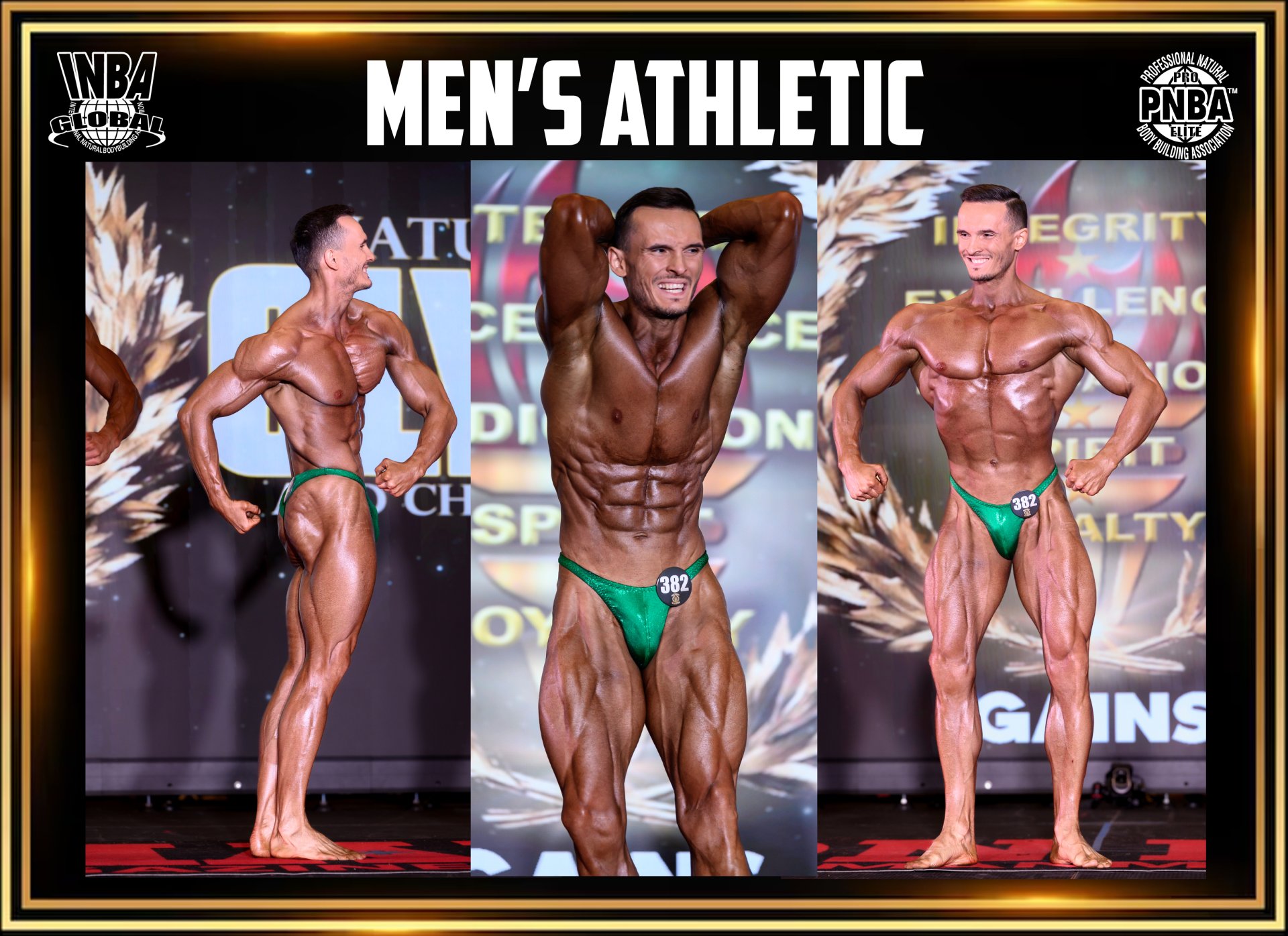
Men’s Athletic Criteria
*Men’s Athletic Category must fulfill the following calculation regarding their bodyweight:
Formula: Body Height (cm) − 103 = Maximum Contest Weight (kg)
U.S. Equivalent: Height (ft/in) and Maximum Contest Weight (lb.) shown for reference.
Example: 179 cm (5 ft 10½ in) body height = Maximum Contest Weight: 76 kg (167.6 lb.)
Example calculation: 179 cm − 103 = 76 kg (167.6 lb.)
- Body-Height in cm – 103 or lighter
Example: 179cm Body-Height – 103: Maximum of 76kg contest weight.
Required Suit
- All athletes must wear a single-colored bodybuilding posing suit that is free of decorations and logos.
- No Strings allowed as posing wear.
- Posing-Suit must be clean with no tanning-cream on it.
- Wearing jewelry is not allowed, except for engagement or wedding ring.
- Wearing a collar, wristband or headband is not allowed.
Judging Criteria
- Muscle Definition & Vascularity (ca. 45% of Overall Judgement)
- Symmetrical muscle development (ca. 30% of Overall Judgement)
- Muscle Mass (ca. 25% of Overall Judgement)
- Stage Presentation
- Body Posture
The competitors of Men’s Athletic Category show no individual posing routine. Judges demand eight poses. Presentation of any other poses that are not asked by the judges is not allowed.
Mandatory Poses
*All athletes enter the stage facing forward to the judges for symmetry semi relaxed quarter turns. Judges may split athletes into different groups, depending on total number of competitors.
1. Front Double Biceps
2. Front Lat Spread
3. Side Chest (side of choice)
4. Side Triceps (side of choice)
5. Back Double Biceps (one leg to the rear, calves flexed)
6. Back Lat Spread (one leg to the rear, calves flexed)
7. Abdominals and thighs (Hands beside head, one leg to the front)
8. Most Muscular (either “crab” Most Muscular or Hands on hips)
Symmetry Round
- Feet must be kept flat on stage.
- Arms should not be overly spread out to the side.
- Twisting of more than 15 degrees in the side poses is not allowed.
- Viewing direction must be equal to foot position, no looking at the judges.
- Body proportions – harmony of muscle development between upper and lower body, back and front as well as left and right body side.
Group and Single comparisons
- To finally decide placings of competitors judges can ask for group or single comparisons of athletes, calling out for quarter turns and/or mandatory poses.
Men’s Athletic Amateur Divisions
- Open
Men’s Athletic Professional Divisions
- Open
- *Professional status is not valid until a PNBA Membership is purchased. PNBA Membership must be renewed annually.
Men’s Bodybuilding Criteria
Required Suit
● Traditional Bodybuilding posing trunks. Not Classic Physique posing trunks.
Judging Criteria
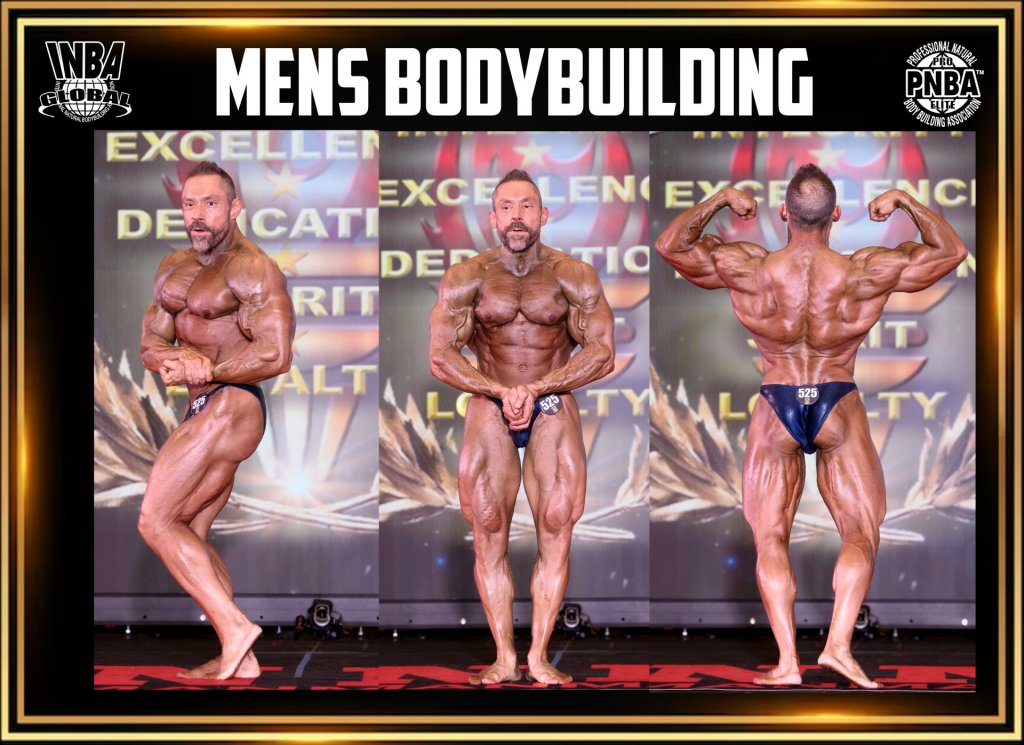
Men’s Bodybuilding consists of two rounds in a group comparison presentation. Judging criteria is based on the following key elements:
Round 1: Symmetry of Proportion
Competitors will stand erect with feet together, arms down at their sides, with shoulders and head facing directly forward. They will execute quarter turns to the right on command from the Head Judge.
○ Symmetry- Left and right sides of the body should mirror each other in size and shape.refers to the balance and correspondence in size, shape, and relative position of body parts on opposite sides of a dividing line, median plane, or central axis.
○ Judges will assess the proportional balance between the following muscle groups:
- Shoulder caps in relation to arms and calves
- Chest size in relation to quadriceps
- Upper torso tapering down to the waist and hips
○ The physique should be aesthetically pleasing and well-balanced from all four angles (front, left side, back, right side). Competitors should aim for a classic “X” frame — broad shoulders, a narrow waist, and balanced muscularity in both the upper and lower body with significant quadriceps sweep,hamstring definition, and balanced calf size.
Round 2: Muscularity, Definition, Separation & Conditioning
Competitors will perform mandatory poses on command from the Head Judge.
- Muscularity: Judges will evaluate overall muscle mass, shape, and fullness. Muscles should be dense and well-formed, showing a balanced distribution across the entire physique.
- Definition: The overall physique must display detailed muscular lines without sacrificing muscle fullness.
- Separation: Must present clear separation between muscle groups, with visible striations and conditioning. An overly stringy or minimal muscle density is not favored.
- Conditioning: Refers to the competitor’s ability to display lean muscle with minimal body fat, emphasizing vascularity and muscle striations. However, extreme “dryness” or an emaciated look is discouraged.
- Stage Presence: Confidence and the ability to showcase one’s physique effectively are crucial. Competitors must maintain proper posture and fluid transitions between poses.
Mandatory Poses
Competitors must execute the following poses with precision, holding each long enough for judges to evaluate muscle engagement, symmetry, and overall presentation:
1. Front Double Biceps – Stand with feet shoulder-width apart, slightly bend your knees and engage your core, raise your arms to the side with elbows slightly above your shoulders, flex your biceps, and externally rotate your shoulders to flare your lats showcasing biceps, lats, and quads.
2. Front Lat Spread – Stand with feet shoulder-width apart, slightly bend your knees, form a fist with your hands (excluding thumbs), and anchor your thumbs to your sides, then bring your elbows out to the sides until they are in line with your torso, flaring your lats to display upper body width.
3. Abdominal and Quadriceps – Hands behind head, flexing abs and quads, emphasizing core and leg definition.
4. Left Or Right Side Chest – Side pose showcasing chest thickness, with one arm bent across the torso and the other flexed.
5. Left Or Right Side Triceps – Side pose with one arm extended downward, highlighting triceps, obliques, and overall side profile.
6. Rear Double Biceps with Calf Flexed – Facing the rear of the stage, raise your arms to the side with elbows slightly above your shoulders, flex your biceps, and externally rotate your shoulders to flare your lats showcasing your back, shoulders, and hamstrings.
7. Rear Lat Spread with Calf Flexed – Facing the rear of the stage stand with feet shoulder-width apart, slightly bend your knees, form a fist with your hands (excluding thumbs), and anchor your thumbs to your sides, then bring your elbows out to the sides until they are in line with your torso, flaring your lats to display upper body width.Arms extended, lats flared, displaying width and symmetry of the back.
8. Hands on Hips Most Muscular – Flexing with hands on hips, contract all front-facing muscles simultaneously, pushing the chest forward, flexing the biceps, and tightening the abs and legs.
9. Crab (The Hulk) Most Muscular – A powerful pose where both arms are flexed inward, contracting the pectorals, obliques, anterior deltoids, biceps, forearms and abdominals highlighting maximum muscle size and vascularity. The quadriceps should also be flexed.
Individual Posing Routine
- Time Limit: Amateur competitors are allowed a maximum of 60 seconds for their posing routine. Professional competitors are allowed 90 seconds.
- Music: Competitors must provide posing routine music before or during registration. Specific instructions will be emailed prior to the competition. Format for posing music MP3 or WAV on either a USB drive or emailed. Digital file must be clearly labeled and easy to locate.
- Objective: The posing routine should highlight the competitor’s physique, conditioning, and overall stage presence. Athletes are encouraged to creatively choreograph their routine to showcase their strengths while maintaining a smooth flow between poses.
Men’s Bodybuilding Amateur Divisions
Divisions are categorized by age, and experience level with height classes applied where permitted:
- Kids (6-8yrs & 9-12yrs)
- Teenage (13-17yrs & 18-19yrs)
- Junior (20-23yrs)
- Jr. Masters (35-39yrs)
- Masters (40-49yrs)
- Grand Masters (50-59yrs)
- Ultra Masters (60-69yrs)
- Super Ultra Masters(70-79)
- Super Platinum Masters (80+yrs)
- Novice – Beginner or has not won first place in a novice category *If first place is achieved in the novice category one may no longer compete as a novice in the same category.
- Open – Experienced or has won first place in a novice category
Professional Qualifying Divisions: Open, Masters, Grand Masters, Ultra Masters Must have a minimum of 3 competitors in each qualifying division for professional qualification to be awarded. Professional Qualification may be issued at judges discretion with only 2 competitors in a category.
Masters Professional Qualification: An overall including Masters,Grand Masters, Ultra Masters, Super Ultra Masters, Super Platinum Masters with 3 or more competitors are eligible to earn professional qualification. Professional Qualification may be issued at judges discretion with only 2 competitors in a category.
*Jr. Masters are not eligible for professional qualification.
Men’s Bodybuilding Professional Divisions
- Open
- Masters (40-49yrs)
- Grand Masters (50-59yrs)
- Ultra Masters (60-69yrs)
*Professional status is not valid until a PNBA Membership is purchased. PNBA Membership must be renewed annually.
Men’s Physique Criteria
Required Suit
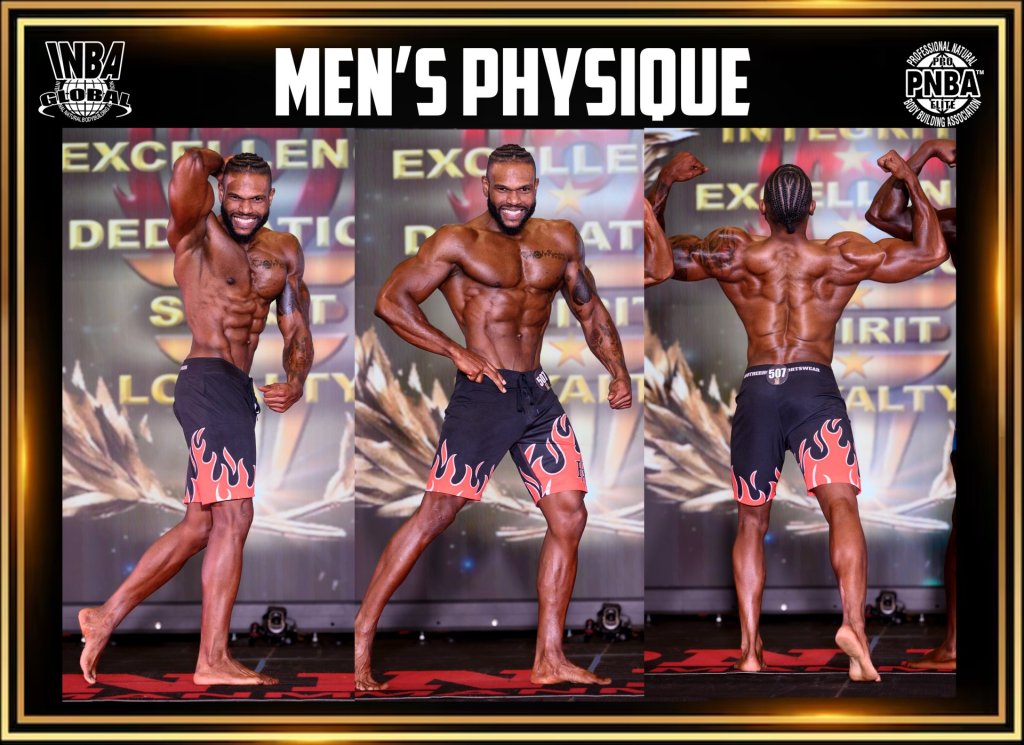
- Competitors must wear board shorts with no elastic waistband. The board shorts must compliment the physique without being excessively tight, or too big. The length should be above the knee but no shorter than mid-thigh. Logos should be minimal and non-distracting.
Judging Criteria
Men’s Physique consists of two rounds in a group comparison presentation. Judging criteria is based on the following key elements:
Round 1: Symmetry and Proportion
Competitors will execute quarter turns to the right on command from the Head Judge. Move smoothly during quarter turns, keeping the flow controlled and polished, ensuring all angles highlight the physique’s symmetry and proportion.
○ Symmetry- Left and right sides of the body should mirror each other in size and shape.
○ Judge while maintaining their “Physique Stage Stance.”
○ Hips down to the calves are exempt from being judged.
○ Key areas of symmetry:
- Shoulder caps to arms
- Chest to lats
- Upper torso tapering down to the waist and hips
○ The physique should be aesthetically pleasing and well-balanced from all four angles (front, left side, back, right side). Competitors should aim for a classic “V-Taper” shape, broad shoulders, wide back, narrow waist, balanced muscularity and conditioning in the upper body.
Round 2: Definition, Separation, Muscularity & Conditioning
Competitors will perform mandatory poses on command from the Head Judge.
- Definition: Highlights the detailed muscular lines without sacrificing muscle fullness.
- Separation: Must present clear separation between muscle groups, with visible striations and conditioning.
- Muscularity: Judges will evaluate overall muscle mass, shape, and fullness. Muscles should be dense and well-formed, showing a balanced distribution across the entire physique, but not the extreme mass of Open Bodybuilding.
- Conditioning: Competitor’s ability to display lean muscle with minimal body fat and vascularity. However, extreme dryness and vascularity seen in Open Bodybuilding are not necessary.
- Stage Presence: Confidence and the ability to showcase one’s physique effectively is crucial. Competitors must maintain proper posture and fluid transitions between poses.
Mandatory Poses
Competitors must execute the following poses with precision, holding each long enough for judges to evaluate muscle engagement, symmetry, and overall presentation:
1. Front Double Biceps – Stand with feet shoulder-width apart, slightly bend your knees and engage your core, raise your arms to the side with elbows slightly above your shoulders, flex your biceps, and externally rotate your shoulders to flare your lats showcasing biceps, lats, and quads.
2. Left Or Right-Side Chest – Side pose showcasing chest thickness, with one arm bent across the torso and the other flexed.
3. Left Or Right-Side Triceps – Side pose with one arm extended downward, highlighting triceps, obliques, and overall side profile.
4. Left Or Right-Side Intercostals – Side pose with one arm behind the head while flexing obliques, and overall side profile.
5. Abdominals – Hands behind head, flexing abs and emphasizing core
6. Rear Double Biceps with Calf Flexed – Facing the rear of the stage, raise your arms to the side with elbows slightly above your shoulders, flex your biceps, and externally rotate your shoulders to flare your lats showcasing your back, shoulders, and hamstrings.
*The following poses are NOT allowed: Front or Back Lat Spread and Crab Most Muscular. Classic Physique poses are not permitted in Men’s Physique.
Men’s Physique Stage Stance: The Men’s Physique Stage Stance is a crucial aspect of presentation, reflecting confidence, symmetry, and balance. Competitors should follow these guidelines for the perfect stance:
- Upper Body: Keep the chest lifted and shoulders slightly back to highlight the width of the upper torso. The arms should hang naturally but with a slight flex to showcase muscle tone.
- Core: Maintain a tight and engaged core, ensuring the abdominal muscles are visible without appearing overly tense.
- Legs: Stand with feet shoulder-width apart or slightly staggered, ensuring a balanced, aesthetic look. Avoid over-flexing the legs; they should appear defined but relaxed.
- Posture: Stand tall with a slight arch in the lower back to emphasize the V-taper (wide shoulders narrowing down to a small waist).
- Facial Expression: Display confidence with a natural smile and maintain eye contact with the judges.
Individual Posing
Competitors will perform either a T-Walk or I-Walk to house music. Be prepared for either or.
- T-Walk:
1. Start from the back center stage marker.
2. Walk to the front center stage marker.
3. Walk to the left stage marker.
4. Walk to the right stage marker.
5. Return to the center stage marker and display a back pose.
- I-Walk:
1. Start from the back center stage marker.
2. Walk to the front center stage marker.
3. Display front and back poses.
The back pose is the final pose for both T-Walk and I-Walk routines. Competitors must follow the stage markers carefully, as these indicate the best lighting for judges and photographers. Failure to follow the designated path may result in point deductions.
Men’s Physique Amateur Divisions
Divisions are categorized by age, and experience level with height classes applied where permitted:
- Teenage (13-17yrs & 18-19yrs)
- Junior (20-23yrs)
- Jr. Masters (35-39yrs)
- Masters (40-49yrs)
- Grand Masters (50-59yrs)
- Ultra Masters (60-69yrs)
- Super Ultra Masters (70-79)
- Novice – Beginner or has not won first place in a novice category *If first place is achieved in the novice category one may no longer compete as a novice in the same category.
- Open – Experienced or has won first place in a novice category
Professional Qualifying Divisions: Open, Masters, Grand Masters, Ultra Masters
Must have a minimum of 3 competitors in each qualifying division for professional qualification to be awarded. Professional Qualification may be issued at judge’s discretion with only 2 competitors in a category.
Masters Professional Qualification: An overall including Masters, Grand Masters, Ultra Masters, Super Ultra Masters, Super Platinum Masters with 3 or more competitors are eligible to earn professional qualification. Professional Qualification may be issued at judge’s discretion with only 2 competitors in a category.
*Jr. Masters are not eligible for professional qualification.
Men’s Physique Professional Divisions
- Open
- Masters (40-49yrs)
- Grand Masters (50-59yrs)
- Ultra Masters (60-69yrs)
*Professional status is not valid until a PNBA Membership is purchased. PNBA Membership must be renewed annually.
Men’s Classic Physique Criteria
Required Suit
- Classic Physique posing trunks with a 4” width preferably black in color. Not Bodybuilding posing trunks.
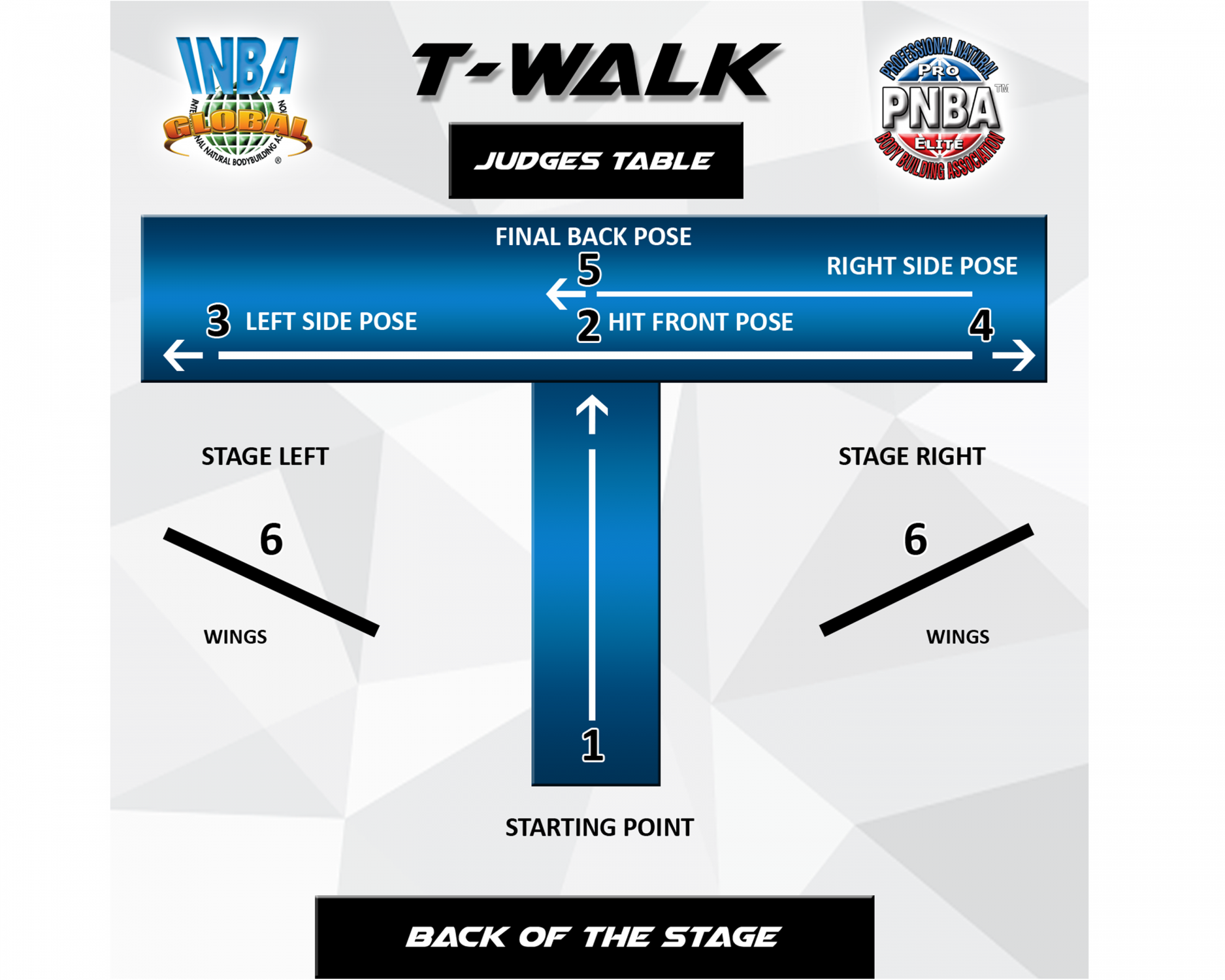
- The Classic Physique division bridges the gap between bodybuilders of the Open division and the leaner, more streamlined Men’s Physique competitors. It emphasizes a balanced, aesthetic, and symmetrical look inspired by the “Golden Era” of bodybuilding (think Frank Zane, Steve Reeves and Arnold Schwarzenegger).
Judging Criteria
Men’s Classic Physique consists of two rounds in a group comparison presentation. Judging criteria is based on the following key elements:
Round 1: Symmetry of Proportion
Competitors will stand erect with feet together, arms down at their sides, with shoulders and head facing directly forward. They will execute quarter turns to the right on command from the Head Judge.
○ Symmetry- Left and right sides of the body should mirror each other in size and shape.
○ Judges will assess the proportional balance between the following muscle groups:
- Shoulder caps in relation to arms and calves
- Chest size in relation to quadriceps
- Upper torso tapering down to the waist and hips
○ The physique should be aesthetically pleasing and well-balanced from all four angles (front, left side, back, right side). Competitors should aim for a classic “X” frame, broad shoulders, a small waist, quadriceps sweep and hamstring definition.
Round 2: Muscularity, Definition, Separation & Conditioning
Competitors will perform mandatory poses on command from the Head Judge.
- Muscularity: Judges will evaluate overall muscle mass, shape, and fullness. Muscles should be dense and well-formed, showing a balanced distribution across the entire physique, but not the extreme mass of Open Bodybuilding.
- Definition: Highlights the detailed muscular lines without sacrificing muscle fullness.
- Separation: Must present clear separation between muscle groups.
- Conditioning: Competitor’s ability to display lean muscle with minimal body fat and vascularity. However, extreme dryness and vascularity along with grainy conditioning seen in Open Bodybuilding are not necessary.
- Stage Presence: Confidence and the ability to showcase one’s physique effectively are crucial. Competitors must maintain proper posture and fluid transitions between poses.
Mandatory Poses
Competitors must execute the following poses with precision, holding each long enough for judges to evaluate muscle engagement, symmetry, and overall presentation:
1. Front Double Biceps – Stand with feet shoulder-width apart, slightly bend your knees and engage your core, raise your arms to the side with elbows slightly above your shoulders, flex your biceps, and externally rotate your shoulders to flare your lats showcasing biceps, lats, and quads.
2. Front Lat Spread – Stand with feet shoulder-width apart, slightly bend your knees, form a fist with your hands (excluding thumbs), and anchor your thumbs to your sides, then bring your elbows out to the sides until they are in line with your torso, flaring your lats to display upper body width.
3. Abdominal and Quadriceps – Hands behind head, flexing abs and quads, emphasizing core and leg definition.
4. Left Or Right-Side Chest – Side pose showcasing chest thickness, with one arm bent across the torso and the other flexed.
5. Left Or Right-Side Triceps – Side pose with one arm extended downward, highlighting triceps, obliques, and overall side profile.
6. Rear Double Biceps with Calf Flexed – Facing the rear of the stage, raise your arms to the side with elbows slightly above your shoulders, flex your biceps, and externally rotate your shoulders to flare your lats showcasing your back, shoulders, and hamstrings.
7. Rear Lat Spread with Calf Flexed – Facing the rear of the stage stand with feet shoulder-width apart, slightly bend your knees, form a fist with your hands (excluding thumbs), and anchor your thumbs to your sides, then bring your elbows out to the sides until they are in line with your torso, flaring your lats to display upper body width. Arms extended, lats flared, displaying width and symmetry of the back.
8. Hands on Hips Most Muscular – Flexing with hands on hips, contract all front-facing muscles simultaneously, pushing the chest forward, flexing the biceps, and tightening the abs and legs.
9. Crab (The Hulk) Most Muscular – A powerful pose where both arms are flexed inward, contracting the pectorals, obliques, anterior deltoids, biceps, forearms and abdominals highlighting maximum muscle size and vascularity. The quadriceps should also be flexed.
Additional Classic Physique Poses:
10. Vacuum Pose: Pulling in the stomach to create a deep abdominal vacuum a staple of Arnold’s posing routine.
11. Victory Pose: Arms raised above the head, showcasing the entire upper body.
12. Twisting Double Biceps: A twisting stance emphasizing the waist and shoulder contrast.
13. Front Double Biceps Pose in a Split Stance: front double bicep poses, squatting down with one leg bent and the other leg extended out.
* An angled stance/sweep stance is highly recommended.
Individual Posing Routine
- 25% of posing routine will count towards overall placement. *Posing routines may be limited to top 5.
- Time Limit: Amateur competitors are allowed a maximum of 60 seconds for their posing routine. Professional competitors are allowed 90 seconds.
- Music: Competitors must provide posing routine music before or during registration. Specific instructions will be emailed prior to the competition. Format for posing music MP3 or WAV on either a USB drive or emailed. Digital file must be clearly labeled and easy to locate.
- Objective: Classic Physique celebrates the art of posing, a direct throwback to the Golden Era emphasizing grace, flow, and the ability to showcase one’s physique with elegance. Poses should highlight an athlete’s strengths and minimize weaknesses while incorporating Classic Physique poses.
*Choice of posing music should emphasize grace, flow, and the ability to showcase one’s physique with elegance.
Men’s Classic Physique Amateur Divisions
Divisions are categorized by age, and experience level with height classes applied where permitted:
- Teenage (13-17yrs & 18-19yrs)
- Junior (20-23yrs)
- Jr. Masters (35-39yrs)
- Masters (40-49yrs)
- Grand Masters (50-59yrs)
- Ultra Masters (60-69yrs)
- Super Ultra Masters (70-79)
- Novice – Beginner or has not won first place in a novice category *If first place is achieved in the novice category one may no longer compete as a novice in the same category.
- Open – Experienced or has won first place in a novice category
Professional Qualifying Divisions: Open, Masters, Grand Masters, Ultra Masters Must have a minimum of 3 competitors in each qualifying division for professional qualification to be awarded. Professional Qualification may be issued at judge’s discretion with only 2 competitors in a category.
Masters Professional Qualification: An overall including Masters, Grand Masters, Ultra Masters, Super Ultra Masters, with 3 or more competitors are eligible to earn professional qualification. Professional Qualification may be issued at judge’s discretion with only 2 competitors in a category.
*Jr. Masters are not eligible for professional qualification.
Men’s Classic Physique Professional Divisions
- Open
- Masters (40-49yrs)
- Grand Masters (50-59yrs)
- Ultra Masters (60-69yrs)
*Professional status is not valid until a PNBA Membership is purchased. PNBA Membership must be renewed annually.
Men’s Sports Model Criteria
Required Suit
- European Style Speedo or Square Cut Swimsuit. No Board shorts.
Judging Criteria
Men’s Sports Model consists of two rounds, T-Walk or I-Walk along with a group comparison of quarter turns. Judging criteria is based on the following key elements:
Round 1: Individual Posing
Competitors will perform either a T-Walk or I-Walk to house music.
- T-Walk:
1. Start from the back center stage marker.
2. Walk to the front center stage marker.
3. Walk to the left stage marker.
4. Walk to the right stage marker.
5. Return to the center stage marker and display a back pose.
- I-Walk:
1. Start from the back center stage marker.
2. Walk to the front center stage marker.
3. Display front and back poses.
The back pose is the final pose for both T-Walk and I-Walk routines. Competitors must follow the stage markers carefully, as these indicate the best lighting for judges and photographers. Failure to follow the designated path may result in point deductions.
Competitors may incorporate the following poses in their T-Walk or I-Walk:
1. Front Double Biceps – Stand with feet shoulder-width apart, slightly bend your knees and engage your core, raise your arms to the side with elbows slightly above your shoulders, flex your biceps, and externally rotate your shoulders to flare your lats showcasing biceps, lats, and quads.
2. Left Or Right Side Intercostals – Side pose with one arm behind the head while flexing obliques, and overall side profile.
3. Abdominals – Hands behind head, flexing abs and emphasizing core
4. Rear Double Biceps with Calf Flexed – Facing the rear of the stage, raise your arms to the side with elbows slightly above your shoulders, flex your biceps, and externally rotate your shoulders to flare your lats showcasing your back, shoulders, and hamstrings.
Round 2: Symmetry, Proportion Definition, Separation, Muscularity & Conditioning
Competitors will perform quarter turns to the right on command from the Head Judge.
- Symmetry: Left and right sides of the body should mirror each other in size and shape.
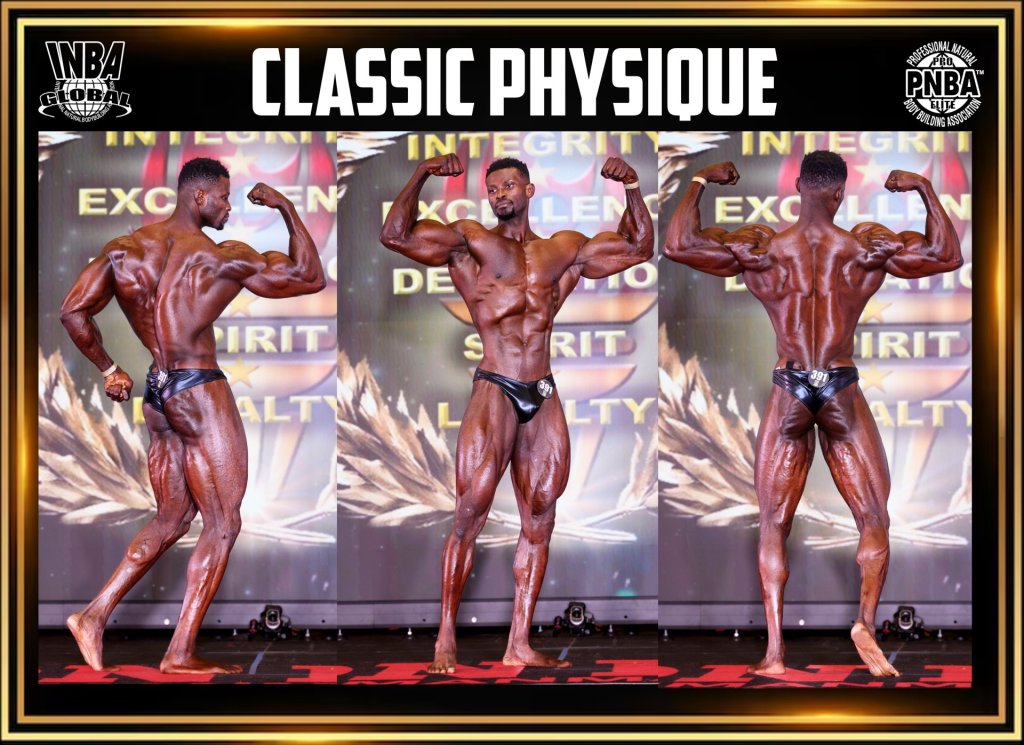
- The physique should be aesthetically pleasing and well-balanced from all four angles (front, left side, back, right side). Competitors should aim for a physique similar to that of a soccer player. An athletic physique with balanced lean muscle mass and conditioning throughout the upper and lower body.
- Definition: Highlights the detailed muscular lines without sacrificing muscle fullness.
- Separation: Must present clear separation between muscle groups, with visible conditioning.
- Muscularity: Judges will evaluate overall muscle mass, shape, and fullness. Muscles should be very lean and toned showing a balanced distribution across the entire physique.
- Conditioning: Competitor’s ability to display lean muscle with minimal body fat and vascularity.
- Stage Presence: Confidence and the ability to showcase one’s physique effectively is crucial.
Men’s Sports Model Amateur Divisions
Divisions are categorized by age, and experience level with height classes applied where permitted:
- Junior (20-23yrs)
- Jr. Masters (35-39yrs)
- Masters (40-49yrs)
- Grand Masters (50-59yrs)
- Ultra Masters (60-69yrs)
- Super Ultra Masters(70-79)
- Novice – Beginner or has not won first place in a novice category *If first place is achieved in the novice category one may no longer compete as a novice in the same category.
- Open – Experienced or has won first place in a novice category
Professional Qualifying Divisions: Open, Masters, Grand Masters, Ultra Masters
Must have a minimum of 3 competitors in each qualifying division for professional qualification to be awarded. Professional Qualification may be issued at judges discretion with only 2 competitors in a category.
Masters Professional Qualification: An overall including Masters, Grand Masters, Ultra Masters, Super Ultra Masters, Super Platinum Masters with 3 or more competitors are eligible to earn professional qualification. Professional Qualification may be issued at judges discretion with only 2 competitors in a category.
*Jr. Masters are not eligible for professional qualification.
Men’s Sprots Model Professional Divisions
- Open
- Masters (40-49yrs)
- Grand Masters (50-59yrs)
- Ultra Masters (60-69yrs)
*Professional status is not valid until a PNBA Membership is purchased. PNBA Membership must be renewed annually.
Men’s Beach Body Criteria
Required Suit
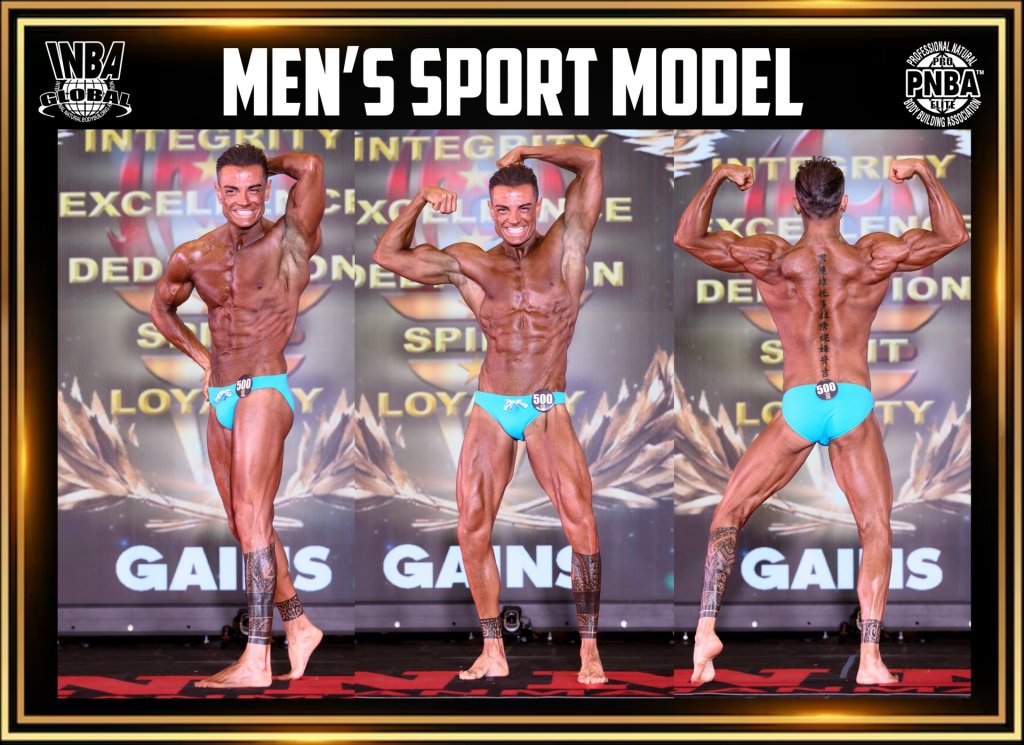
- Swim shorts with elastic waist line or board shorts.
Judging Criteria
Beach Body consists of two rounds, T-Walk or I-Walk along with a group comparison of quarter turns. Judging criteria is based on the following key elements:
Round 1: Individual Posing
Competitors will perform either a T-Walk or I-Walk to house music.
- T-Walk:
1. Start from the back center stage marker.
2. Walk to the front center stage marker.
3. Walk to the left stage marker.
4. Walk to the right stage marker.
5. Return to the center stage marker and display a back pose.
- I-Walk:
1. Start from the back center stage marker.
2. Walk to the front center stage marker.
3. Display front and back poses.
The back pose is the final pose for both T-Walk and I-Walk routines. Competitors must follow the stage markers carefully, as these indicate the best lighting for judges and photographers. Failure to follow the designated path may result in point deductions.
Competitors may incorporate the following poses in their T-Walk or I-Walk:
1. Front Double Biceps – Stand with feet shoulder-width apart, slightly bend your knees and engage your core, raise your arms to the side with elbows slightly above your shoulders, flex your biceps, and externally rotate your shoulders to flare your lats showcasing biceps, lats, and quads.
2. Left Or Right Side Intercostals – Side pose with one arm behind the head while flexing obliques, and overall side profile.
3. Abdominals – Hands behind head, flexing abs and emphasizing core
4. Rear Double Biceps with Calf Flexed – Facing the rear of the stage, raise your arms to the side with elbows slightly above your shoulders, flex your biceps, and externally rotate your shoulders to flare your lats showcasing your back, shoulders, and hamstrings.
Round 2: Symmetry, Proportion, Definition, Muscularity & Conditioning
Competitors will perform quarter turns to the right on command from the Head Judge.
- Symmetry: Left and right sides of the body should mirror each other in size and shape.
- The physique should be aesthetically pleasing and well-balanced from all four angles (front, left side, back, right side). Competitors should aim for a balanced physique with some muscle mass with slight muscle definition and conditioning throughout the upper body and torso.
- Definition: Highlights the detailed muscular lines without sacrificing muscle fullness.
- Separation: Must present clear separation between muscle groups, with visible conditioning.
- Muscularity: Judges will evaluate overall muscle mass, shape, and fullness.
- Conditioning: Competitor’s ability to display some lean muscle with some body fat.
- Stage Presence: Confidence and the ability to showcase one’s physique effectively is crucial.
Beach Body Amateur
- True Novice – Have never competed before. Entry level division leading to Men’s Physique Novice.
*Experienced competitors may not compete in Beach Body.
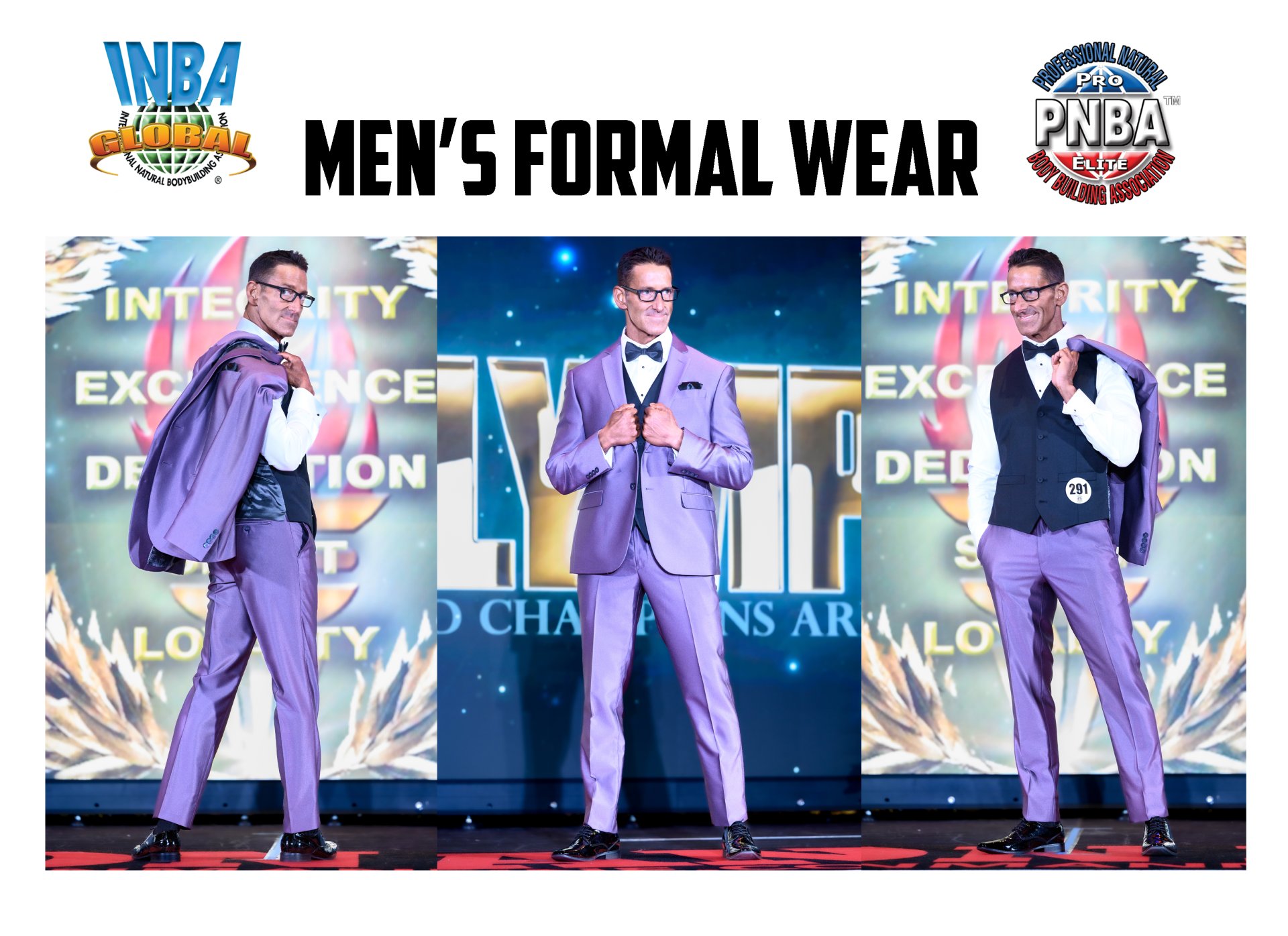
Men’s Formal Wear Criteria
Required Suit
- All competitors are required to wear formal attire. Physical structure, confidence and style are being judged. No jeans. Vests are acceptable. No hats or overcoats. A well-conditioned body dressed in GQ style is desired.
Judging Criteria
- 50%- Physique
- 50%- Stage Presence
Competitors will perform individual T-Walk to house music.
Competitors will perform quarter turns for comparisons.
Men’s Body Quest Criteria
Required Suit
- Attire that best compliments your physique and is comfortable. (Formal or business suit, workout attire or board shorts)
Men’s Body Quest is not a competitive category rather a celebration of achievement and health.
The judges will be looking for a combination of these objectives:
1. Quest for your healthy fit body
2. Quest for a fit and healthy Lifestyle
3. Quest for your body transformation
4. Quest to change your life forever
5. Quest to look, feel and be your best!
6. Quest to eliminate health issues
7. Quest to your self-confidence
8. Quest for your fitness goals
Examples: Obesity, Diabetes, Cholesterol, Rehabilitation (injury), Mental Health, Physical Disabilities, Pregnancy Weight, or Low-Self Esteem. A person’s transformation of their body, health and soul with the support system you design for yourself (trainer, spouse, significant other, family, friends) or all of the above.
A before photo is required to be on stage with you for your reveal. Poster board must be no smaller than 24×36. One will need to provide a document explaining your Body Quest journey in 200 words and submit the document at check-ins.
Individual Posing
Perform either a T-Walk or I-Walk to house music.
- T-Walk:
1. Start from the back center stage marker.
2. Walk to the front center stage marker.
3. Walk to the left stage marker.
4. Walk to the right stage marker.
5. Return to the center stage marker and display a back pose.
- I-Walk:
1. Start from the back center stage marker.
2. Walk to the front center stage marker.
3. Display front and back poses.
The back pose is the final pose for both T-Walk and I-Walk routines. One must follow the stage markers carefully, as these indicate the best lighting for judges and photographers.
One may incorporate any bodybuilding poses they feel comfortable performing in their T-Walk or I-Walk.
After T-Walk or I-Walk is performed the head judge will have you perform quarter turns to the right ending in a 360* turn, and an award will be presented.
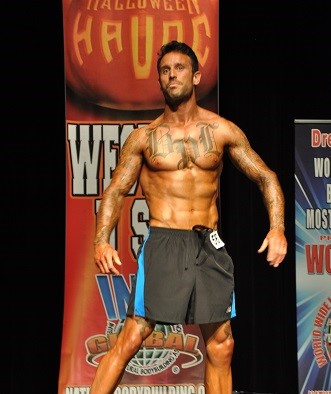
Men’s Ink /Tattoo Criteria
Required Suit
- Board shorts OR Posing Trunks
Judging Criteria
- Consists of One Round. Judging Criteria is based on Ink/Tattoos that are visible, presentation, individuality, confidence, and composure. Round 1- Consists of T-Walk OR I-Walk, Symmetry of Proportion: Definition: Correspondence in size, shape, and relative position of parts on opposite sides of a dividing line or center of axis. Competitors will make quarter turns to the right on command. The competitor will give a 30 second speech explaining the significance of their Ink/Tattoos.
Individual Posing
- Perform a T-Walk OR I-Walk T- Walk: Start from the back center stage marker Walk to the front center stage marker Walk to the left stage marker Walk to the right stage marker Walk back to the center stage marker, display back pose I-Walk: Start from the back center stage marker Walk to the front center stage marker, display front and back pose
- ***The Back Pose is the last pose performed during T-Walk OR I-Walk*** Not following the markers on stage and the steps listed above may result in deduction of points. (The markers on stage represent the best lighting for judges and photographers)
Men’s Ink /Tattoo Amateur Divisions
- Open
Kids & Teen Fitness
Required Suit
No Specific Outfit Required (Age Appropriate)
Judging Criteria
Consists of One Round in a group comparison presentation.
Judging Criteria is based on symmetry, athletic definition, and stage presence.
Round 1- Symmetry of Proportion: Definition: Correspondence in size, shape, and relative position of parts on opposite sides of a dividing line or center of axis.
Competitors will be instructed by the Head Judge to stand erect with their feet together, and arms down to their sides of their torso, shoulders and head facing directly front.
Competitors will make quarter turns to the right on command as they are judged on overall balance, shape of their physique. Their structure should be overall aesthetically pleasing from all four sides viewed.
Individual Posing Routine
Each competitor will be allowed a maximum of 90 seconds (some events will have a time restraint of 60 seconds) to display their flexibility, strength, and endurance. Competitors can perform any activity they have excelled in. (i.e. bodybuilding, martial arts, gymnastics, dance, aerobics, ANY fitness activity) Competitor to provide posing routine music at registration. CD in audio format.

Kids & Teen Fitness Divisions
Boys (6-8yrs)
Teen (13-17yrs)
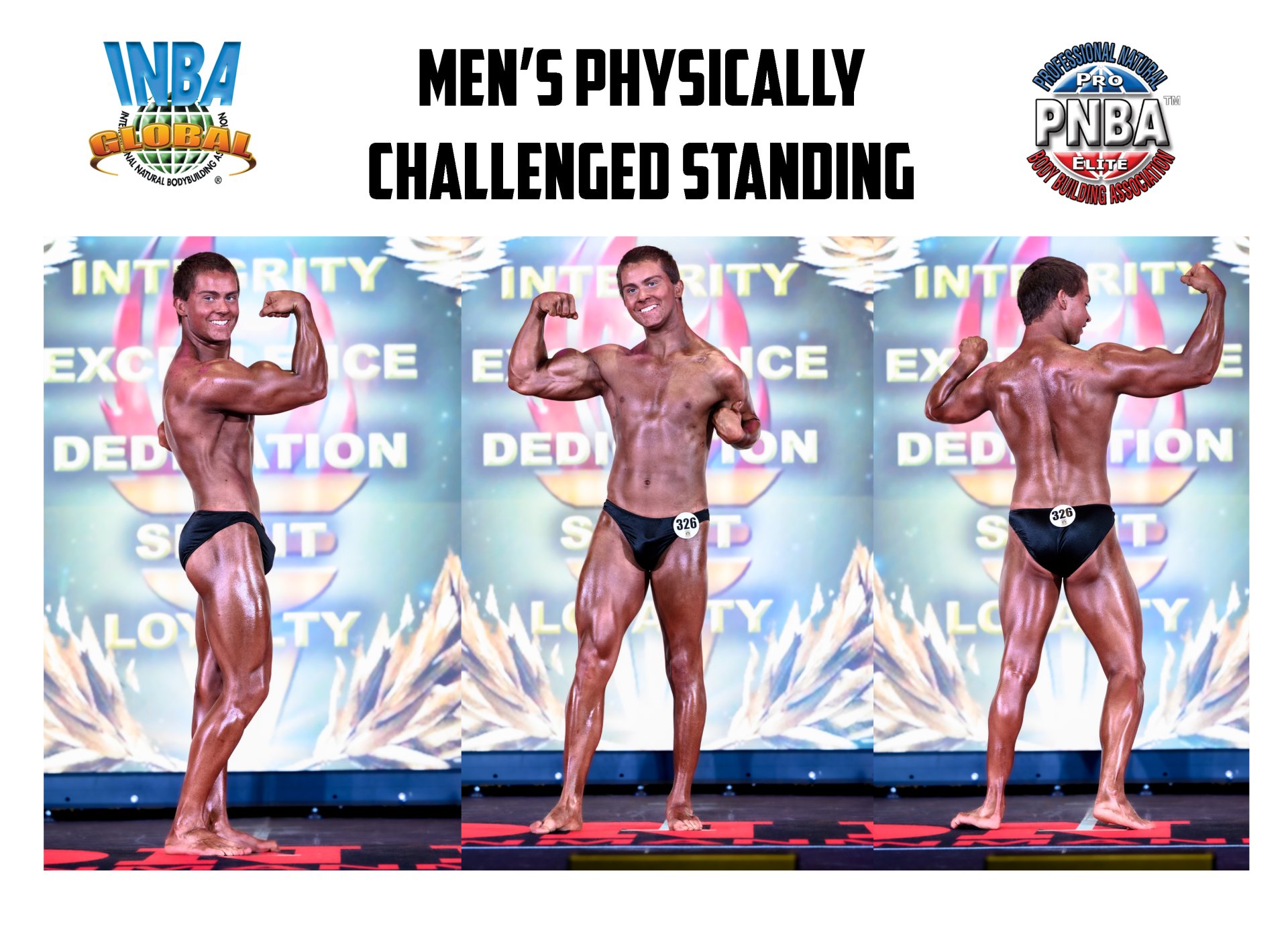
Men’s Physically Challenged Standing
Required Suit
Bodybuilding Male Posing Trunks
Judging Criteria
Consists of One Round in a group comparison presentation.
Judging Criteria is based on symmetry, muscularity, definition, (conditioning) and stage presence.
Round 1- Symmetry of Proportion: Definition: Correspondence in size, shape, and relative position of parts on opposite sides of a dividing line or center of axis.
Competitors will be instructed by the Head Judge to stand erect with their feet together, and arms down to their sides of their torso, shoulders and head facing directly front.
Competitors will make quarter turns to the right on command as they are judged on overall balance, shape of their physique. Their structure should be overall aesthetically pleasing from all four sides viewed.
Symmetry is defined as the proportional balance of opposite body parts such as:
Shoulder caps to the arms and to the calfs
Barrel of the chest to the quadriceps together
Upper torso tapering down to the waist and hips
Round 1- Muscularity, Definition & Separation: Competitors will perform a number of mandatory poses on command of the Head Judge. The competitors will be judged on overall muscularity and size, muscle shape and fullness, and muscle density.
Definition is judged on the competitor’s distinct muscular detail level that separates the different muscle groups of their physique while attaining the mass and fullness of their muscle groups.
Mandatory Poses
- Front Double Biceps
- Front Lat Spread
- Abdominals and Quadriceps
- Left Side Chest
- Left Side Triceps
- Rear Double Biceps w/ Right Calf Flexed
- Rear Lat Spread w/ Left calf Flexed
- Rear Double Calf Flexed
- Right Side Chest
- Right Side Triceps
- Hands on Hips Most Muscular
- Crab (The Hulk) Most Muscular
Individual Posing Routine
Each competitor will be allowed a maximum of 90 seconds (some events will have a time restraint of 60 seconds) to display their physique, physical conditioning, and the competitors overall presentation through their posing routine. Competitor to provide posing routine music at registration. CD in audio format.
Men’s Bodybuilding Divisions
Open Men
Men’s Physically Challenged Wheelchair
Required Suit
Athletic Attire (Competitors choice)
Judging Criteria
Consists of One Round in a group comparison presentation.
Judging Criteria is based on symmetry, muscularity, definition, (conditioning) and stage presence.
Round 1- Symmetry of Proportion: Definition: Correspondence in size, shape, and relative position of parts on opposite sides of a dividing line or center of axis.
Competitors will make quarter turns to the right on command as they are judged on overall balance, shape of their physique. Their structure should be overall aesthetically pleasing from all four sides viewed.
Symmetry is defined as the proportional balance of opposite body parts such as:
Shoulder caps to the arms and to the calfs
Barrel of the chest to the quadriceps together
Upper torso tapering down to the waist and hips
Round 1- Muscularity, Definition & Separation: Competitors will perform a number of mandatory poses on command of the Head Judge. The competitors will be judged on overall muscularity and size, muscle shape and fullness, and muscle density.
Definition is judged on the competitor’s distinct muscular detail level that separates the different muscle groups of their physique while attaining the mass and fullness of their muscle groups.
Mandatory Poses
- Front Double Biceps
- Front Lat Spread
- Abdominals and Quadriceps (Optional)
- Left Side Chest
- Left Side Triceps
- Rear Double Biceps
- Rear Lat Spread
- Rear Double
- Right Side Chest
- Right Side Triceps
- Hands on Hips Most Muscular
- Crab (The Hulk) Most Muscular

Individual Posing Routine
Each competitor will be allowed a maximum of 90 seconds (some events will have a time restraint of 60 seconds) to display their physique, physical conditioning, and the competitors overall presentation through their posing routine. Competitor to provide posing routine music at registration. CD in audio format.
Men’s Bodybuilding Divisions
Open Men
Mixed Pairs
Required Suit
Male: Bodybuilding Posing Trunks
Female: Bodybuilding or Bikini Suit
Judging Criteria
Consists of Two Rounds in a group comparison & posing routine. All rounds are judged.
Judging Criteria is based on the pairs symmetry, muscularity, definition, (conditioning) and stage presence.
Round 1- Symmetry of Proportion: Definition: Correspondence in size, shape, a relative position of parts on opposite sides of a dividing line or median plan or center of axis.
Symmetry is defined as the proportional balance of opposite body parts such as:
Shoulder caps to the arms and to the calfs
Barrel of the chest to the quadriceps together
Upper torso tapering down to the waist and hips
Definition is judged on the competitor’s distinct muscular detail level that separates the different muscle groups of their physique while attaining the mass and fullness of their muscle groups. A very conditioned and very stringy runners look is NOT acceptable in this division.
Competitors will be instructed by the Head Judge to stand erect with their feet together, and arms down to their sides of their torso, shoulders and head facing directly front.
Competitors will make quarter turns to the right on command as they are judged on overall balance, shape of their physique. Their structure should be overall aesthetically pleasing from all four sides viewed.
Mandatory Poses
- Front Double Biceps
- Front Lat Spread
- Abdominal and Quadriceps
- Left Side Chest
- Left Side Triceps
- Rear Double Biceps w/ Calf Flexed
- Rear Lat Spread w/ Calf Flexed
- Right Side Chest
- Right Side Triceps
- Hands on Hips Most Muscular
- Crab (The Hulk) Most Muscular
Individual Posing Routine
Each Mixed Pair will be allowed a maximum of 90 seconds (some events will have a max of 60 seconds) Creativity and Synchronized Pose(s) must be portrayed in posing routine along with presentation of physique and physical conditioning in the overall routine. Competitors to provide posing routine music at registration in a USB (Universal Serial Bus) your music must be labeled and easy to find. No cell phones.

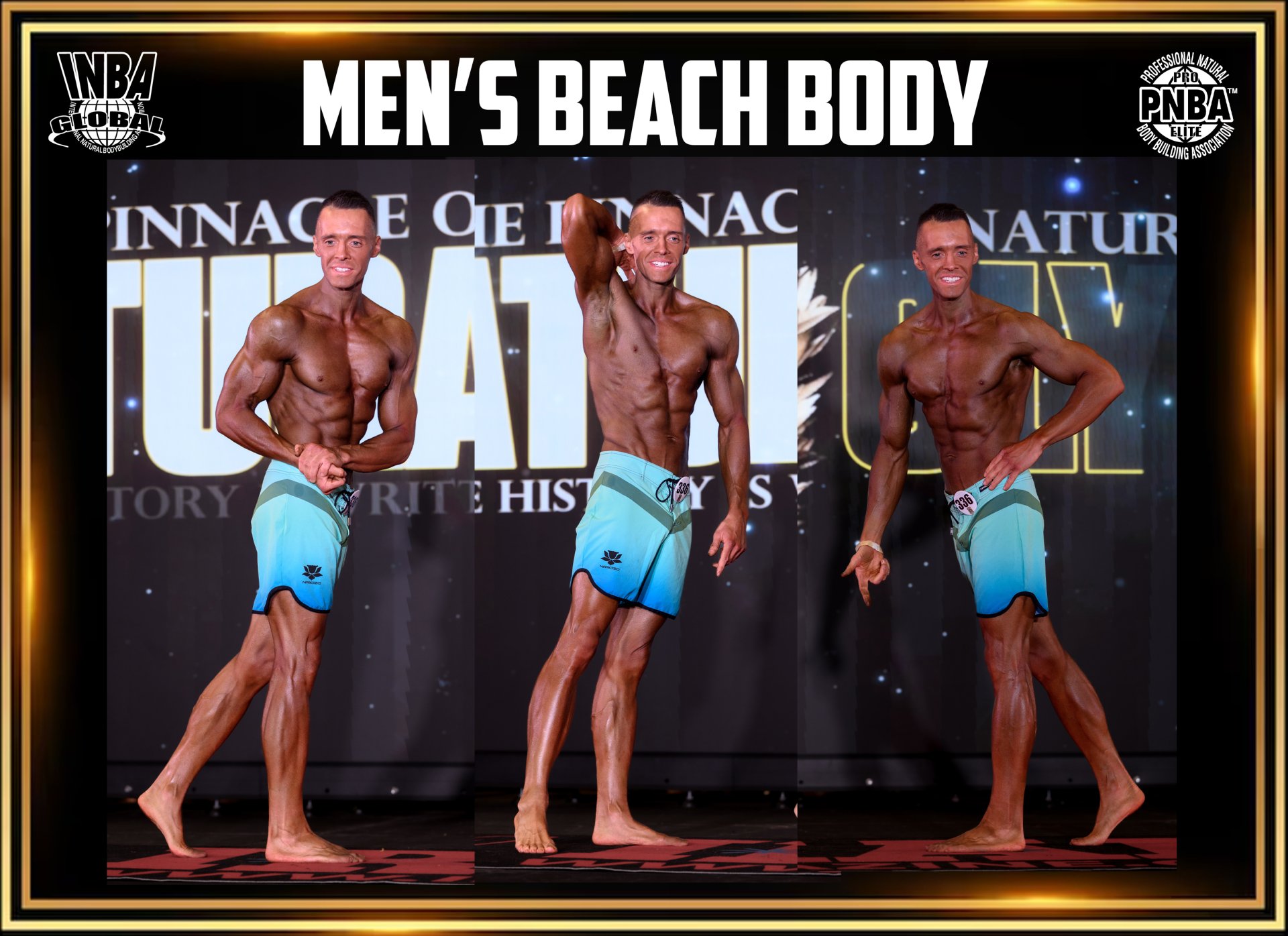
HOW TO PERFORM A T-WALK
1. You will start from the back of the stage and walk towards the center stage.
2. You will then hit your front pose while in center stage (marked on the ground)
3. Walk from the center stage towards the left and you will then hit your left side pose (marked on the ground)
4. Walk across the stage to the far right side of the stage where you will hit your right side pose (marked on the ground)
5. Walk back towards the center of the stage where you will hit your final back pose.
6 You will then be told to head off to one of the wings on either stage left or stage right.
Advertisement